

The Classic Dry Martini Recipe

Dry Martini in the Summer

The Classic Dry Martini Recipe

The Dry Martini is probably the most iconic cocktail out there. And when it is made right, it makes sense why.

I remember reading Henry Craddock’s The Savoy Cocktail Book, where he suggests shaking a Martini. Something most bartenders today would disagree with. Still, that version stuck around. Mostly because of James Bond’s famous line, ā€œshaken, not stirred.ā€

But this is not that Martini.

This one is stirred.

The story of the Dry Martini

Few cocktails are as talked about as the Dry Martini. It is often described as the most iconic cocktail ever made, and at the same time one of the most misunderstood.

On paper it is extremely simple. Gin and dry vermouth. But in reality the Dry Martini is one of the most debated cocktails in history. Ratios, technique, garnish, even whether vermouth should be used at all. Everyone has an opinion.

Like many classic cocktails, the exact origin is unclear. Most historians agree that the Dry Martini evolved from an earlier cocktail called the Martinez, a drink made with gin, sweet vermouth, maraschino and bitters in the late 1800s. Over time the style shifted. The vermouth became drier, the ratios changed, and the drink moved closer to what we now recognize as a Dry Martini.

The rise of London Dry Gin in the early 20th century played a big role in this transition. Its clean and structured profile made it a natural fit for a more minimal cocktail. Around the same time, vermouth brands like Martini & Rossi became widely known, and the name ā€œMartiniā€ started to stick.

At some point the drink became less about balance and more about preference. Some like it with a proper measure of vermouth. Others want just a rinse. Some stir for a long time, others keep it short. The Dry Martini became less of a fixed recipe and more of a personal definition.

That is also what makes it interesting.

A well made Dry Martini is clean, cold and precise. There is nowhere to hide. Every decision matters. The gin, the vermouth, the dilution, even the temperature of the glass.

It is not always a cocktail people love the first time they try it. But once it makes sense, it tends to stay.

Choosing the ingredients

Gin:

A Dry Martini is built almost entirely on gin, which makes the choice of gin essential.

For this recipe we use Tanqueray No. Ten, a classic London Dry style gin with a slightly more refined and citrus forward profile.

Tanqueray No. Ten has the expected juniper backbone, but also fresh notes of grapefruit, lime and orange. This gives the Martini a cleaner and more defined profile without making it feel sharp.

Because the ingredient list is so short, the gin does most of the work. A well balanced gin ensures that the cocktail feels precise rather than aggressive.

In a Dry Martini there is nowhere to hide. The quality of the gin will define the drink from start to finish.

Ā 

Dry vermouth:

For the vermouth we use Noilly Prat Original Dry, a classic French dry vermouth.

Noilly Prat is known for its herbal and slightly saline profile, which works well in a Martini. It adds structure and complexity without making the drink feel heavy.

In a Dry Martini the vermouth is used in a smaller amount than in many other cocktails, but it still plays an important role. It softens the gin and adds depth, even in small quantities.

As with all vermouth, freshness matters. Once opened, it should be stored in the refrigerator and used within a reasonable time to keep the flavors intact.

Garnish

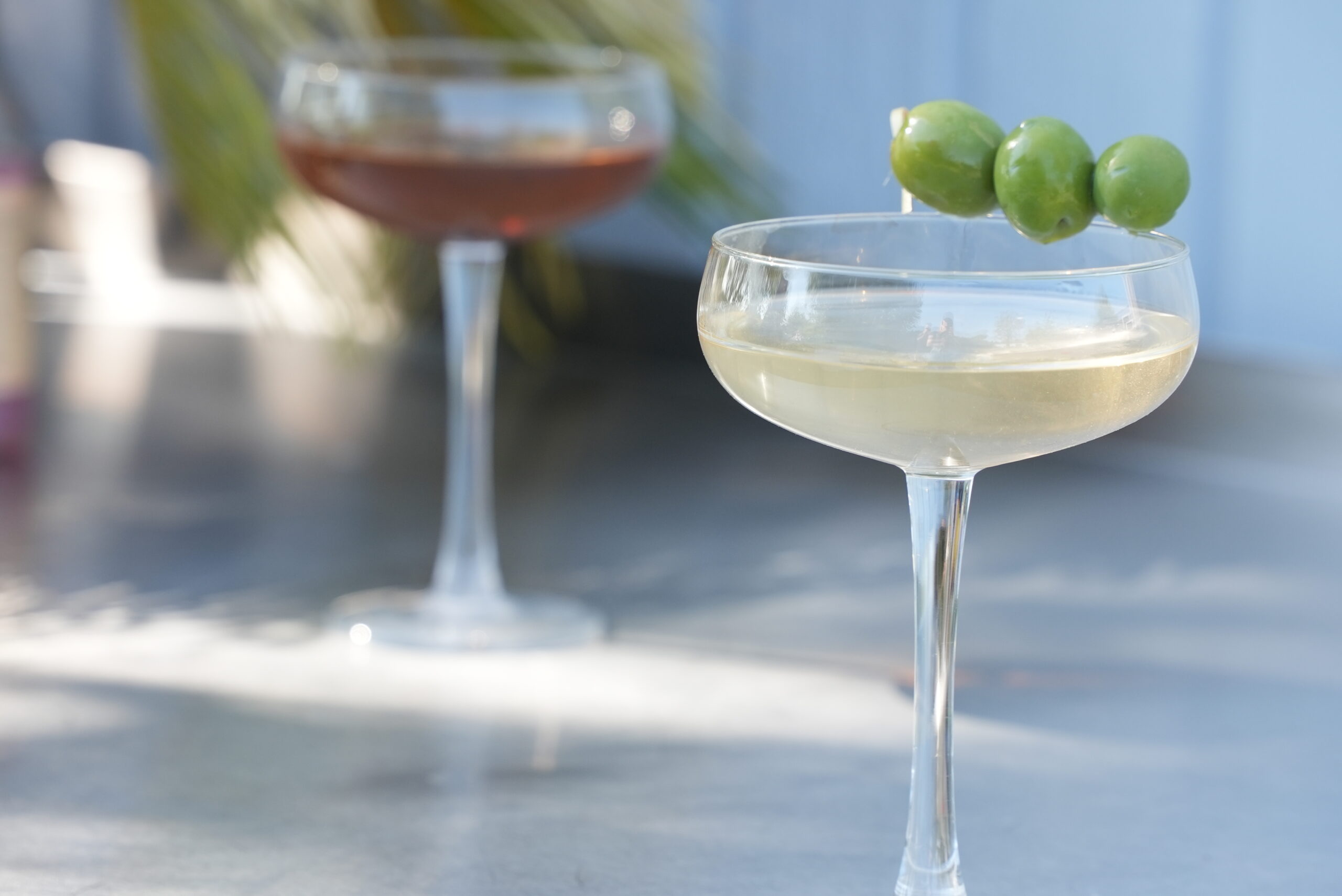
The classic garnish for a Dry Martini is an olive.

The olive adds a subtle salinity that complements the dryness of the cocktail. It also reinforces the clean and savory character that defines a Martini.

When serving with olives, it is traditional to use an odd number, typically one or three, placed on a cocktail pick. It is a small detail, but part of the ritual that surrounds the drink.

Some prefer an olive, others prefer a lemon twist. Both are traditional, but they create slightly different expressions of the cocktail.

The olive makes the drink rounder and more savory, while a lemon twist adds a lighter, fresher aroma.

Dry Martini

A classic Dry Martini cocktail recipe with gin and dry vermouth. Learn how to make a clean and well balanced martini using Tanqueray No. Ten and Noilly Prat.
Prep Time 3 minutes
Build time 5 minutes
Total Time 8 minutes
Servings: 1 cocktail
Course: Drinks
Calories: 205

Ingredients
  

The Cocktail
  • 7 cl Gin
  • 1 cl Dry Vermouth
  • Ice cubes
Garnish
  • 1 Cocktail pick
  • 1 or 3 Olives

Equipment

  • 1 Jigger
  • 1 Bar Spoon
  • 1 Martini / cocktail glass
  • 1 Stirring / Mixing glass
  • 1 Julep strainer

Method
 

Preparation
  1. Chill your martini or coupe glass with ice or place it in a freezer. Remove the ice from the glass before serving.
  2. Chill the stirring glass with ice cubes, then discard the water before building the cocktail.
  3. Prepare the garnish by placing an odd number of olives on a cocktail pick.
Instructions
  1. Add gin and dry vermouth to the stirring glass.
  2. Fill the stirring glass with ice.
  3. Stir the cocktail for 20-25 second until it's well chilled.
  4. Strain the cocktail into a chilled martini glas.
  5. Add the olives as garnish and serve.

Common Mistakes

A Dry Martini should always be stirred, not shaken. Shaking introduces air and creates small ice shards that make the drink cloudy and more diluted.

What to Remember

  • Use quality spirits - In the classics the quality of the spirit is of the highest importance.
  • Always stir the cocktail - A Dry Martini should be stirred with ice, not shaken. Stirring keeps the drink clear, smooth and properly diluted.

  • Chill everything - A Martini should be served very cold. Chill both the glass and the mixing glass before making the cocktail.
  • Use proper ice - Large ice cubes give better control over dilution and help maintain the clean texture of the drink.

FAQ

  • What is a Dry Martini made of - A Dry Martini is made with gin and dry vermouth, and is typically garnished with either an olive or a lemon twist.
  • Why is a Dry Martini stirred and not shaken - A Dry Martini should be stirred with ice to keep the drink clear and smooth. Shaking introduces air and makes the cocktail cloudy and overly diluted.
  • What is the alcohol percentage of an Espresso Martini? - The alcohol percentage in a Cosmopolitan typically ranges between 13 - 18 % ABV, depending on dilution and proportions.
  • Can you make a Dry Martini with vodka -Yes, but it becomes a different cocktail, often referred to as a Vodka Martini / Kangaroo Kick. The classic Dry Martini is made with gin.
Sources
No Comments

Post A Comment
Recipe Rating